Database Paradigms
Relational DB
- Rigid structure enforced by table's
schema - Has support for
transactions(ACID compliant) - Difficult to scale horizontally (scale-up instead of scale-out)
- Slower read operations on large analytical workloads
-
On-line Transaction Processing (OLTP)
-
Implementations
- MySQL / MariaDB
- Postgres (most popular open-source choice in 2026)
- SQL Server
- RDS & Aurora (AWS)
NewSQL / Distributed SQL
- Combines relational guarantees (ACID, SQL) with horizontal scalability
- Designed for geo-distributed deployments
- Handles high write throughput without sacrificing consistency
-
Bridges the gap between traditional RDBMS and NoSQL scalability
-
Implementations
- CockroachDB
- TiDB
- Google Spanner / AlloyDB
- PlanetScale (MySQL-compatible)
- Neon (serverless Postgres)
Key-Value DB
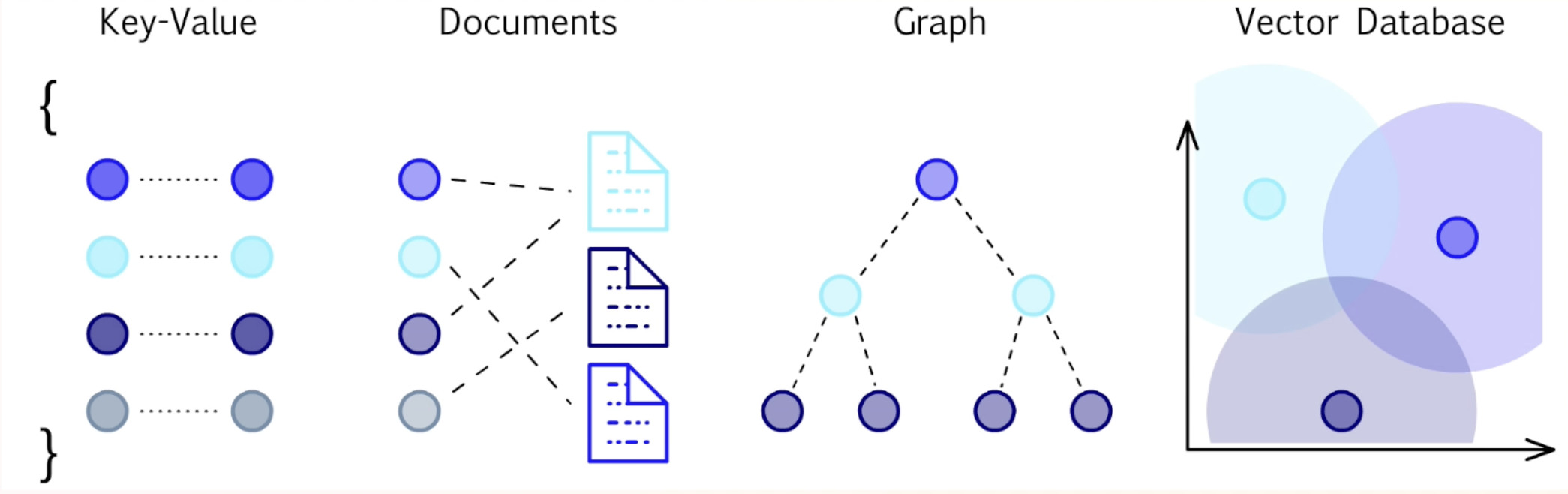
- It's a large scale hash table
- Data commonly stored in RAM (or optionally persisted to disk)
- Perfect use-case for caches, sessions, pub/sub, and counters
-
Some implementations now also support vector search and streaming
-
Implementations
- Redis / Redis Stack (with vector & search modules)
- Valkey (open-source Redis fork maintained by Linux Foundation)
- Memcached
- Etcd (distributed config & leader election)
- DragonflyDB (Redis-compatible, high throughput)
Document Oriented DB
- Each document is a container for key-value pairs (typically JSON/BSON)
- No schema (flexible/schemaless)
- Documents are grouped together in collections
-
Good for hierarchical or nested data
-
Implementations
- MongoDB
- Firestore (GCP)
- DynamoDB (AWS, also key-value hybrid)
- CouchDB
- SurrealDB (multi-model with document support)
Columnar / OLAP DB
- Data is stored column-by-column instead of row-by-row
- Optimized for analytical queries (aggregations, scans) over large datasets
- On-line Analytical Processing (OLAP)
-
Often used in data warehousing and business intelligence
-
Implementations
- DuckDB (in-process, embeddable — very popular for local analytics)
- ClickHouse (real-time analytics at scale)
- Apache Parquet + Iceberg (open table format)
- Snowflake
- BigQuery (GCP)
- Redshift (AWS)
- Apache Druid (real-time ingestion)
Wide-Column DB
- Keys store multiple columns (values) organized in column families
- No schema
- Good for time-series data, historical records, high-write, low-read workloads
-
Scales horizontally to petabytes
-
Implementations
- Cassandra
- HBase
- ScyllaDB (Cassandra-compatible, higher throughput)
- Google Bigtable
Time-Series DB
- Optimized for sequential, timestamped data points
- Efficient compression and retention policies
- Common in observability, IoT, metrics, and financial tick data
-
Supports downsampling and time-based aggregations natively
-
Implementations
- InfluxDB
- TimescaleDB (Postgres extension)
- Prometheus (metrics, pull-based)
- VictoriaMetrics (Prometheus-compatible, high cardinality)
- QuestDB (SQL-based, high ingestion rate)
Vector DB
- Connects data that is similar (semantic proximity in embedding space)
- Stores high-dimensional vector embeddings (from ML models)
- Enables semantic/similarity search via Approximate Nearest Neighbor (ANN)
- Core infrastructure for RAG (Retrieval-Augmented Generation) pipelines and AI applications
-
Rapidly growing paradigm since 2023
-
Implementations
Pinecone: SaaS, very population for AI appsWeaviate: Open-source, graphQL APIQdrant: Open-source, Rust-basedMilvus: Open-source, large-scaleChroma: lightweight, local-first, prototypingPgvector:Postgres extensionOpenSearch: general-purpose search engine with k-NN plugin for ANN vector search; supports hybrid (keyword + vector) queries
Graph DB
- Connects data that is connected (explicit relationships between entities)
- Data is represented as
nodes(vertices) with properties - Relationships are represented as
edges(can be directed and weighted) -
Two main models: Property Graphs (Neo4j) and RDF/Triple Stores (SPARQL)
-
Use cases
- Fraud detection in finance
- Recommendation engines
- Knowledge graphs
-
Social network analysis
-
Implementations
- Neo4j
- Amazon Neptune
- DGraph
- FalkorDB (Redis-based, fast property graph)
- Kuzu (embeddable, DuckDB-style for graphs)
Search DB
- Analyze and index text content for full-text search
- Support relevance ranking, faceting, typo-tolerance
-
Good for search bars, e-commerce product search, log search
-
Implementations
- Elasticsearch / OpenSearch
- Apache Solr (built on Lucene)
- Algolia (managed SaaS)
- MeiliSearch (open-source, easy to self-host)
- Typesense (open-source, fast)