Finite state machine (FSM)
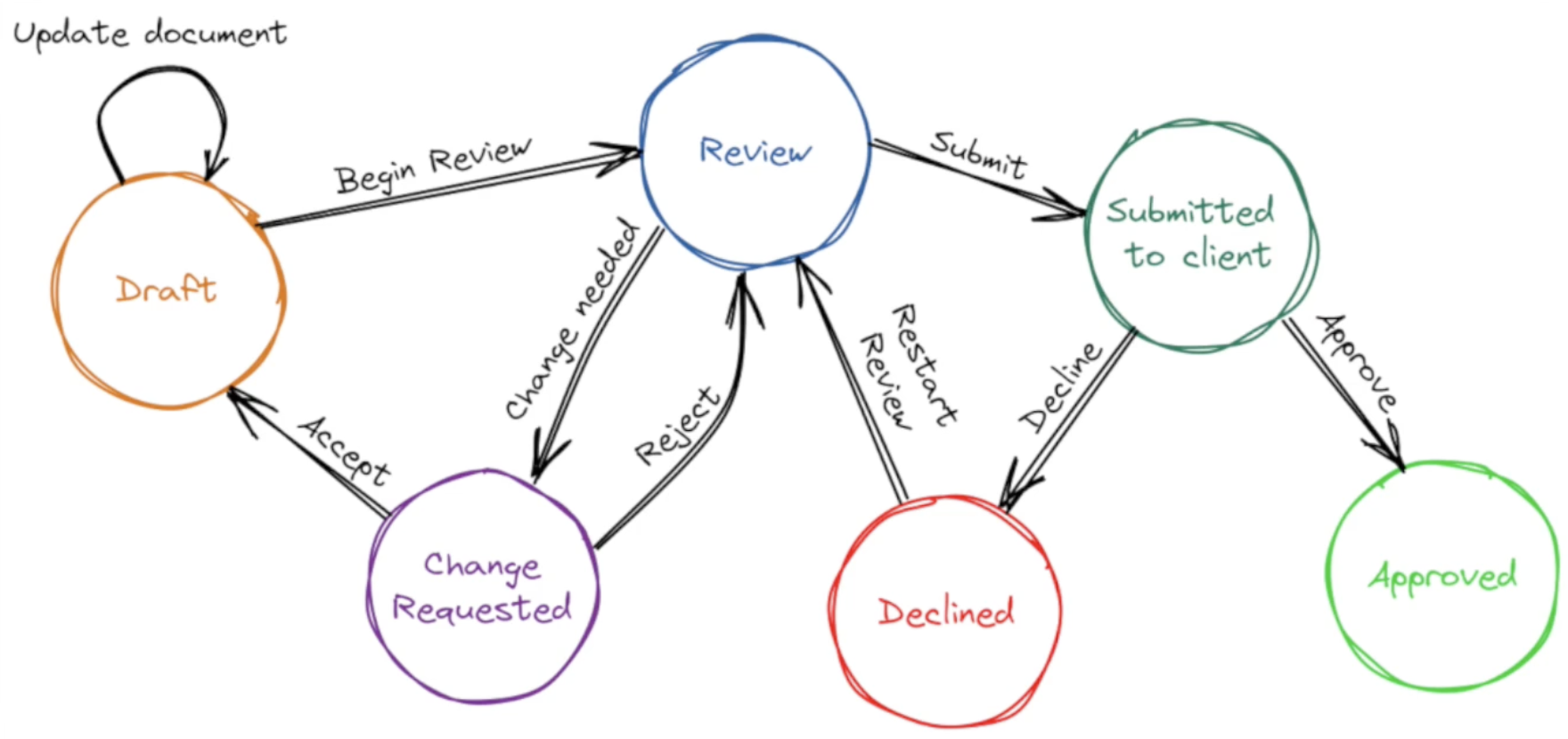
- It's a computational model that describes a system with a fixed set of
states, wheretransitionsbetween states are triggered byinputs or events. -
It's a directed graph
-
States - discrete configurations the system can be in (e.g., idle, loading, error)
- Transitions - rules for moving from one state to another
- Inputs/Events - what triggers a transition (e.g., submit, timeout)
- Initial state — where the machine starts (and optionally, accepting/final states)
Analysis
- Reachability analysis — graph traversal (BFS/DFS) can determine if a state is reachable from the initial state, or if dead states exist
- Cycle detection — identifies infinite loops (e.g., a retry loop that never terminates)
- Minimization — FSM minimization algorithms (like Hopcroft's) work on the graph structure to merge equivalent states
- Visualization — tools like Mermaid and XState render FSMs as literal node-edge diagrams